Modeling Reinforced Concrete Stiffness
Part 1: Material Behavior
By Adam Stordahl, PE • Published July 29, 2025
This post kicks off our series on modeling concrete stiffness across different levels: material, section, and structural. Let’s start at the most fundamental level—the material itself.
At the material level, stiffness is described by the slope of the stress-strain curve. Hooke’s law captures this for a linear material:
σ = E · ε, where E is Young’s modulus, or the stiffness of the material. Pretty simple. Everyone is familiar with
seeing values for Esteel and Econcrete (just look in the IES material database). However, it quickly gets
more complex than that.
Steel Constitutive Model
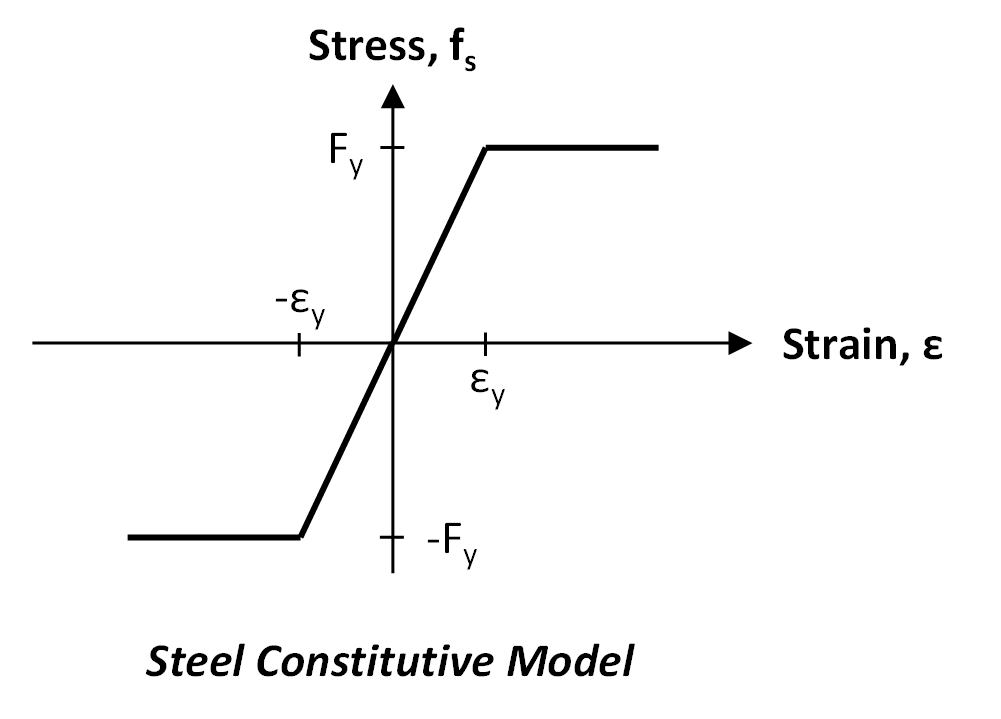
The steel stress-strain model is often idealized as having a constant Young’s modulus of 29,000 ksi in both tension and compression. The stiffness is constant until the material yields, at which point, the slope of the curve is zero. That is, after the bars yield, they have no ability to resist further deformations.
Physically, this means that steel is very stiff—until it isn’t at all. In reinforced concrete analysis, we are often interested in load levels that yield the reinforcing, so we cannot ignore that second slope.
So, how stiff is the steel in a reinforced-concrete section? It depends on how much you load it.
Concrete Constitutive Model
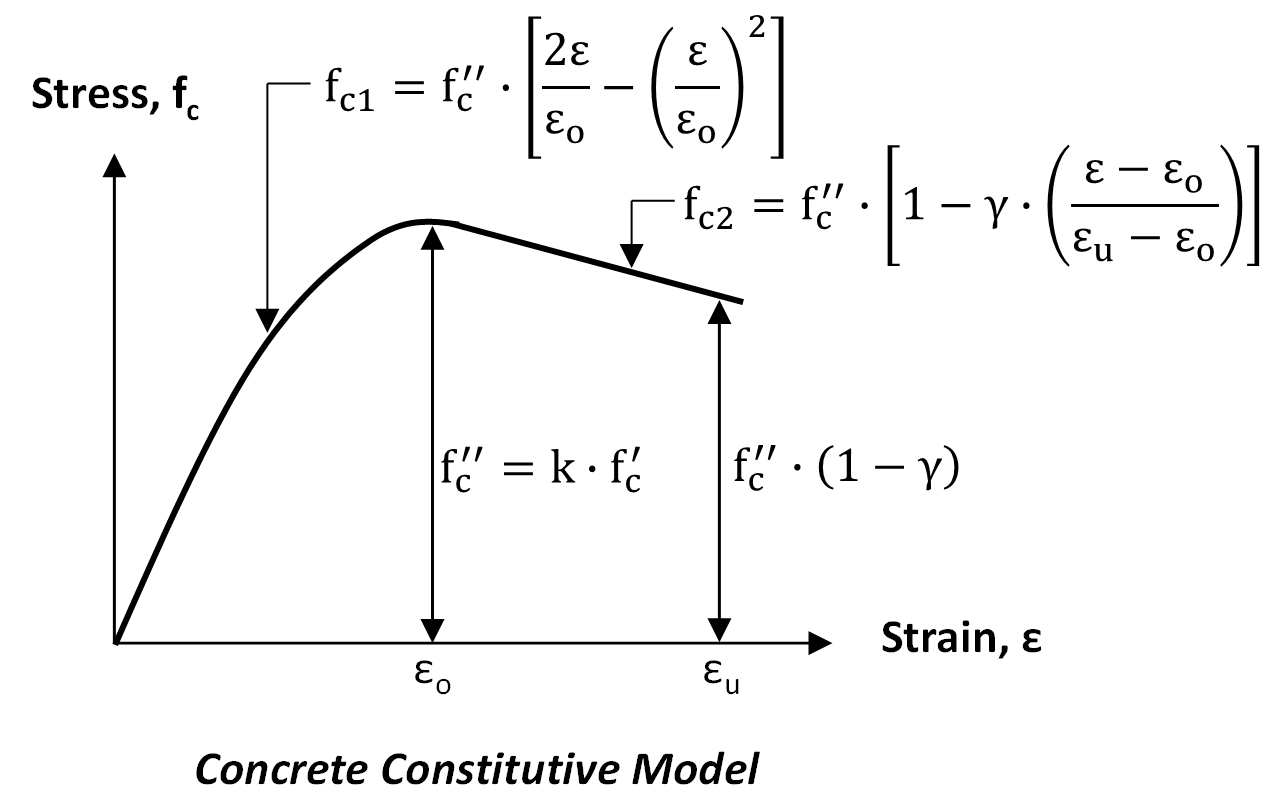
The plot above shows a popular constitutive model for concrete developed by Hognestad (Hognestad, 1951, Bulletin No. 399, University of Illinois). This is the model used in ConcreteSection.
The first thing that jumps out in this model is that concrete has no stiffness (or capacity for that matter) in tension. Second,
the shape of the curve in compression is never straight. The slope is zero
(no stiffness) when the stress reaches f′c (a pretty important point on the curve) and becomes negative after that.
So how can a parameter like Econcrete be defined? The short answer is it can’t be, since concrete is clearly never
a linear material. That’s technically true—but in practice, approximate values for Econcrete show up often. So,
the next question is: which slope should we use?
-
Initial Tangent Modulus
This is the slope at the origin of the stress-strain curve. It’s the material’s stiffness when a load is first introduced. It might be useful for finding an initial displacement. It’s the largest stiffness (biggest slope) on the curve. -
Secant Modulus
This is the slope from the origin to a specified point on the curve (for example, the peak stress). It represents the average stiffness over that range. It might be useful when an average response over a range of loads is sufficient. -
ACI 318
ACI 318-19 Section 19.2.2.1 states thatEconcretecan be estimated for “general design use” as57,000 · √f′c. This formulation is a secant modulus to a point on the curve at 0.45 ·f′c. This implies the approximation is valid only for service-level loads—far below ultimate. This approach significantly overestimates concrete stiffness when stresses are nearf′c. -
Tangent Modulus
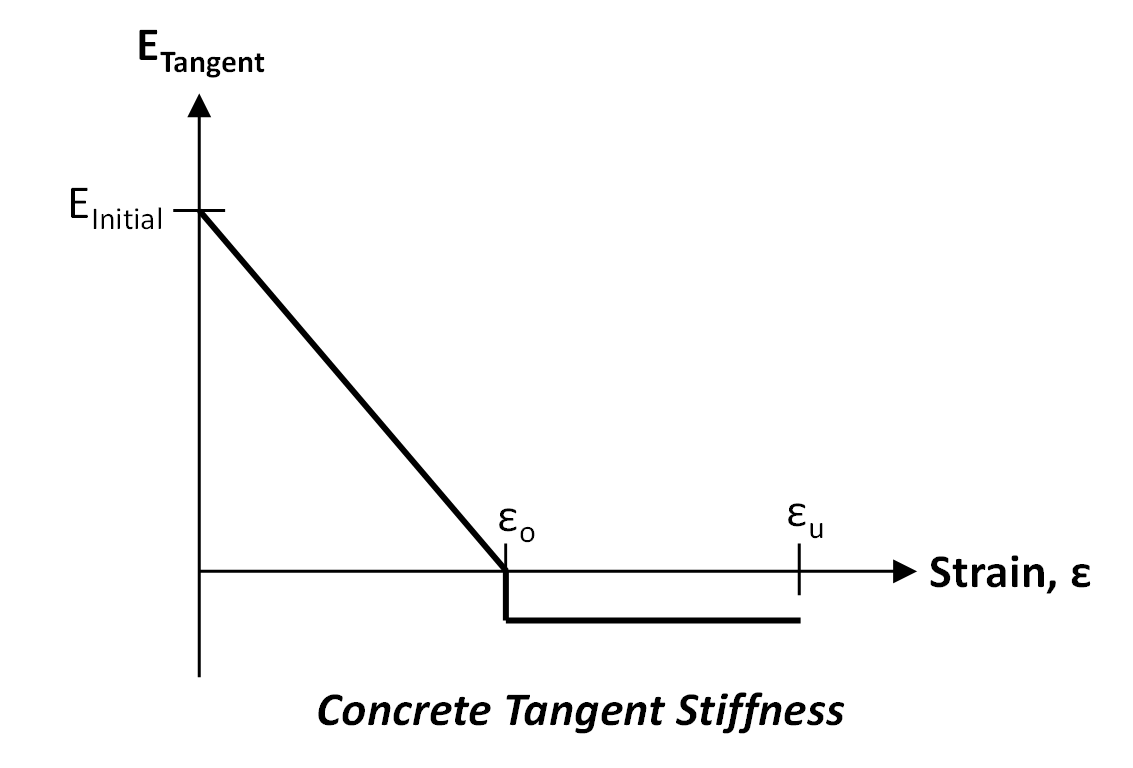
As mentioned earlier, there is no single value that describes the stiffness of concrete. The slope of the curve changes at every point. The robust way to answer the concrete-stiffness question is to find the slope at every point along the curve; that is, take the derivative of stress with respect to strain. This derivative gives the Tangent Modulus.
\( E_{\text{Tangent}} = \frac{d\sigma}{d\varepsilon} \)
The plot below shows the derivative of the constitutive model. If concrete were linear, this plot would be a constant horizontal line. It clearly isn’t. Notice how much the stiffness degrades as the strains increase.
While this approach is robust, it certainly isn’t convenient. As we’ll see later in this series, it takes some effort to use a stiffness value that’s only valid at a particular load level.
So, how stiff is the concrete in a reinforced-concrete section? It depends on how much you load it.
Closing Thoughts: Why This Matters
The stiffness of both steel and concrete varies significantly depending on the load level. More specifically, both materials soften as they approach their ultimate capacity. This makes it essential to consider how much load is being applied when making modeling decisions.
For example, ACI’s Econcrete approximation may be appropriate when estimating the deflection of a beam at
(lower) service-level loads, where the concrete and steel are still behaving relatively stiff. But the same approximation
may be inappropriate when analyzing an indeterminate structure at or near ultimate capacity, where the reduced stiffness
has a major impact on force distribution.
Next Time:
Part 2: Section Stiffness and Moment-Curvature
We’ll dive into how concrete stiffness affects beam and column behavior, and why it’s not as simple as just plugging in
“cracked I” or “gross I”.